Saudi Payroll Accounting: GOSI, Wages Protection System (WPS / Mudad) & EOSB Guide
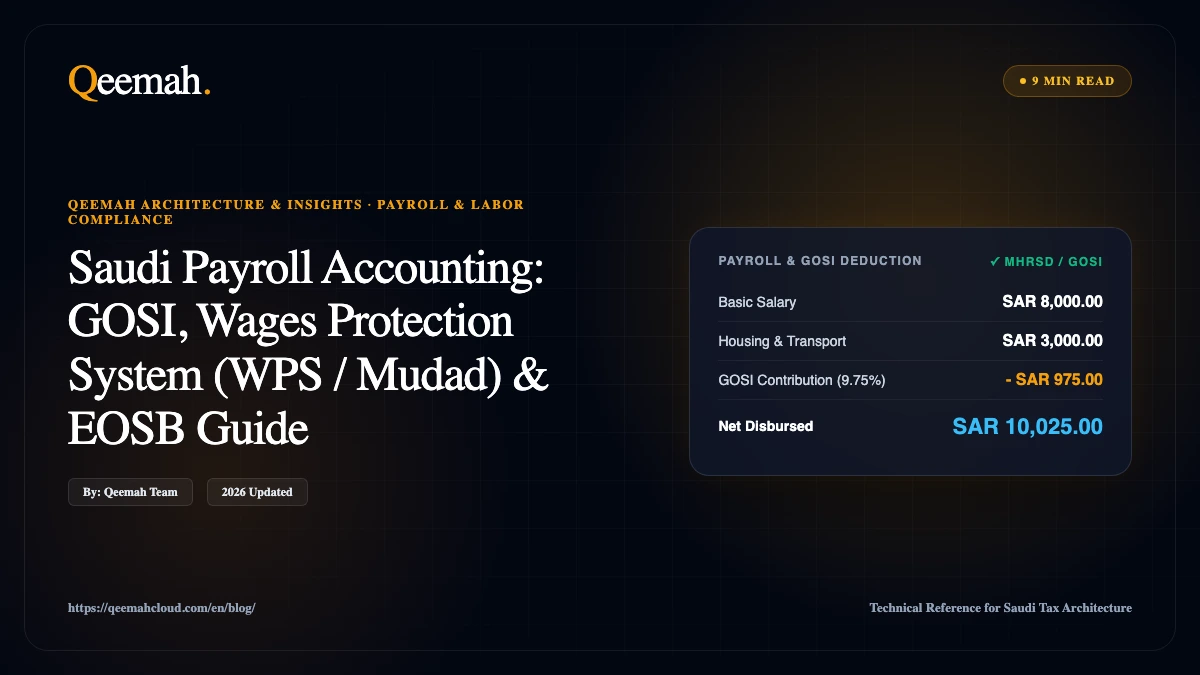
Authoritative corporate payroll guide for Saudi Arabia. GOSI calculation formulas for Saudi and expat employees, WPS Mudad file formatting, and Labor Law EOSB calculations.
Summarize or verify this guide with AI:
Opens your preferred AI assistant with this article and ZATCA compliance context pre-loaded.
Operating compliant payroll in Saudi Arabia requires full synchronicity across three distinct statutory systems: the General Organization for Social Insurance (GOSI), the Ministry of Human Resources Wages Protection System (WPS via Mudad), and statutory End-of-Service Benefits (EOSB) under the Saudi Labor Law.
This guide provides finance and HR teams with the exact mathematical formulas, journal entries, and automated file specs necessary for 100% audit-ready compliance.
1. GOSI Contribution Rates (Contributory Wage Rules)
GOSI deductions apply strictly to the employee’s Contributory Wage, defined as: $$\text{Contributory Wage} = \text{Basic Salary} + \text{Actual or Fixed Housing Allowance}$$ (Subject to a statutory minimum of 1,500 SAR and a maximum cap of 45,000 SAR per month).
Contribution Breakdown
| Employee Category | Employer Share | Employee Deduction | Total Remitted to GOSI |
|---|---|---|---|
| Saudi National | 11.75% • 9.0% Annuities (Pension) • 2.0% Occupational Hazards • 0.75% Saned Unemployment | 9.75% • 9.0% Annuities • 0.75% Saned | 21.5% |
| Non-Saudi (Expat) | 2.0% • 2.0% Occupational Hazards | 0.0% (No deduction from salary) | 2.0% |
Note: For GCC nationals working in KSA, contributions follow the unified cross-border social insurance extension system of their home nation.
2. Standard Monthly Payroll Journal Entry
Assume a company with:
- Saudi Employees: Contributory Wages = 50,000 SAR
- Expat Employees: Contributory Wages = 50,000 SAR
- Total Gross Wages = 100,000 SAR
Calculations:
- Saudi GOSI Employee Deduction: $50,000 \times 9.75% = 4,875\text{ SAR}$
- Saudi GOSI Employer Expense: $50,000 \times 11.75% = 5,875\text{ SAR}$
- Expat GOSI Employer Expense: $50,000 \times 2.0% = 1,000\text{ SAR}$
- Total GOSI Payable to Government: $4,875 + 5,875 + 1,000 = 11,750\text{ SAR}$
- Net Salaries Payable to Bank: $100,000 - 4,875 = 95,125\text{ SAR}$
💡 Quick Calculation: Compute your company and employee deductions instantly using our free GOSI calculator.
Journal Entry:
Debit: Salaries & Wages Expense (5201) — 100,000 SAR
Debit: Employer GOSI Contribution Expense (5202) — 6,875 SAR
Credit: GOSI Regulatory Payable (2153) — 11,750 SAR
Credit: Net Salaries Payable / Bank Clearing (2105) — 95,125 SAR
3. Wages Protection System (WPS / Mudad) Workflow
Saudi Arabia enforces WPS compliance through the Mudad platform:
- Format Requirements: The payroll engine must generate an encrypted text or CSV banking file (
.sif) containing:- Employer CR Number and Bank Identifier Code (BIC)
- Value Date (disbursement date)
- Employee National ID / Iqama Number
- Employee IBAN (validate formatting with our Saudi IBAN validator tool)
- Total Gross Salary, Basic, Housing, Deductions, and Net Amount
- Thresholds: The Ministry of Human Resources tracks payment compliance. At least 80% of active registered workers must receive their verified contractual salary via WPS on a monthly basis to avoid labor visa blocks and penalties.
4. End of Service Benefits (EOSB) Formula (Article 84 & 85)
Under Article 84 of the Saudi Labor Law, EOSB is based on the final wage (including fixed allowances):
$$\text{EOSB (Years 1 to 5)} = \text{Years of Service} \times \left(\frac{\text{Last Monthly Wage}}{2}\right)$$ $$\text{EOSB (Year 6+)} = 5 \times \left(\frac{\text{Last Monthly Wage}}{2}\right) + (\text{Years of Service} - 5) \times \text{Last Monthly Wage}$$
Resignation Reductions (Article 85):
If the employee resigns voluntarily, entitlements are adjusted:
- Less than 2 years of service: 0% entitlement.
- 2 to 5 years of service: 1/3 (33.3%) of calculated benefit.
- 5 to 10 years of service: 2/3 (66.7%) of calculated benefit.
- 10+ years of service: 100% full entitlement.
- Contract termination by employer: 100% full entitlement regardless of tenure.
💡 Severance Estimation: Calculate statutory severance benefits in seconds using our Saudi EOSB calculator.
5. Automating Saudi Payroll with Modern Cloud ERP
In modern systems like Qeemah Cloud (منصة قيمة السحابية), GOSI percentages, WPS file exports, and EOSB monthly accrual provisions are calculated automatically upon entry of the employment contract, eliminating spreadsheet discrepancies and ensuring full compliance with both the Ministry of Human Resources and ZATCA audits.
Next Steps
Automate GOSI deductions, EOSB accruals, and monthly WPS SIF payroll generation with Qeemah: Explore Saudi Accounting & Payroll | Learn About WPS Integration | Free GOSI Calculator | Book a Guided Demo
Frequently Asked Questions
What is the total GOSI contribution percentage for Saudi employees in 2026?
For Saudi nationals, the total GOSI contribution is 21.5% of the contributory wage (Basic Salary + Housing Allowance, capped at 45,000 SAR/month). The employer pays 11.75% (9% Annuities + 2% Occupational Hazards + 0.75% Saned Unemployment Insurance), while the employee pays 9.75% (9% Annuities + 0.75% Saned) deducted directly from their salary.
How much does GOSI deduct for non-Saudi (expat) employees?
For non-Saudi employees, there is zero deduction from the employee's salary. The employer pays 2.0% of the contributory wage to cover Occupational Hazards.
What is the Wages Protection System (WPS / Mudad) requirement in KSA?
All Saudi private sector entities must disburse employee salaries through approved commercial banks using a standardized WPS text/Sif file format uploaded to the Ministry of Human Resources Mudad platform by the 10th of every month, achieving at least an 80% compliance wage-matching threshold.
How is End of Service Benefit (EOSB) calculated under Article 84 of the Saudi Labor Law?
Under Article 84, EOSB is based on the final total wage: half a month's wage for each of the first 5 years of service, and one full month's wage for each subsequent year. In cases of resignation (Article 85), entitlements scale from 0% (under 2 years), one-third (2-5 years), two-thirds (5-10 years), to 100% (after 10 years).