What is PINT-AE? The New UAE E-Invoicing Standard Explained
A deep dive into the PINT-AE XML format, UBL 2.1, and why PDFs are no longer compliant in the UAE.
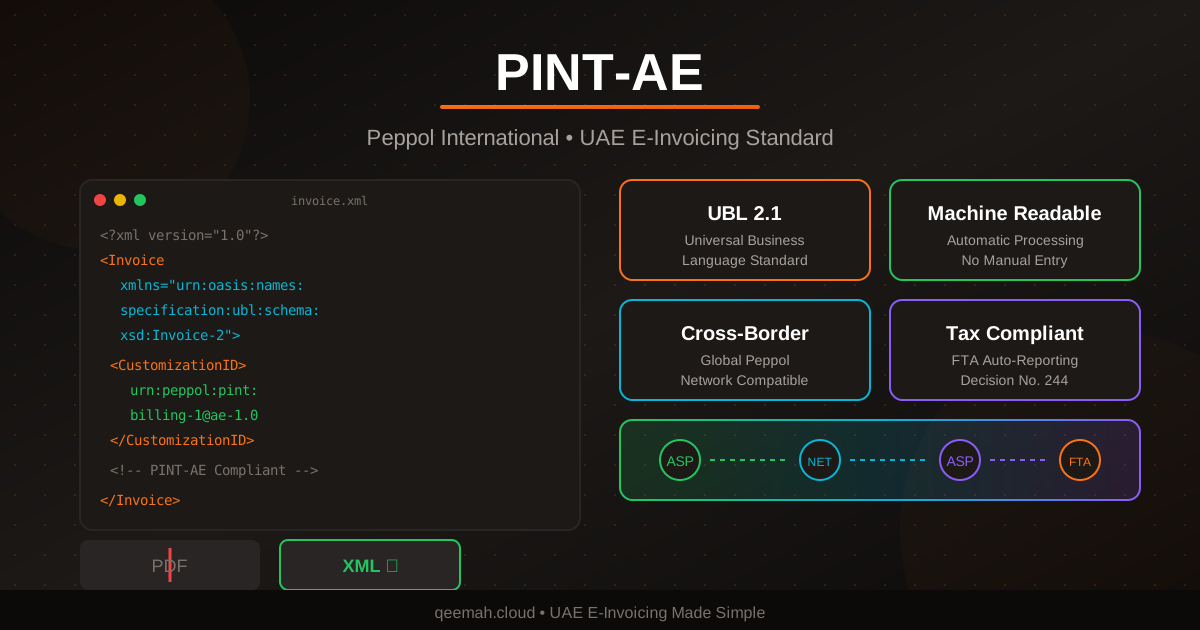
As the UAE moves towards a fully digital economy, the days of sending PDF invoices by email are numbered. The new National E-Invoicing System introduces a specific technical standard known as PINT-AE.
For business owners and IT managers, understanding PINT-AE is crucial. It’s not just a file format; it’s the language your business must speak to remain compliant.
What is PINT-AE?
PINT stands for Peppol International. It is a global specification designed to enable cross-border e-invoicing. PINT-AE is the localized version specifically tailored for the United Arab Emirates 1.
It is built on UBL 2.1 (Universal Business Language), a standard XML format used globally. This ensures that an invoice sent from a supplier in Dubai can be automatically read and processed by a buyer’s system in Abu Dhabi—or even internationally—without human intervention 2.
Key Differences: PDF vs. PINT-AE XML
| Feature | Traditional PDF | PINT-AE XML |
|---|---|---|
| Readability | Human-readable | Machine-readable |
| Data Entry | Manual (prone to error) | Automatic (instant) |
| Validation | Visual check | Automated rule check |
| Compliance | Not compliant (Phase 2) | Mandatory |
The Anatomy of a PINT-AE Invoice
A PINT-AE invoice is a structured data file. It follows a strict “Data Dictionary” defined by the UAE Federal Tax Authority. Here are some of the critical components (Business Terms):
1. The Specification ID (IBT-024)
Every invoice must declare that it follows the UAE standard.
urn:peppol:pint:billing-1@ae-1
2. The Parties (IBT-031 & IBT-048)
- Seller TRN: Mandatory 15-digit VAT number.
- Buyer TRN: Conditional (Required for B2B transactions) 3.
3. Line Items & Tax
Unlike a simple total, every line item must be detailed with:
- Item name and description.
- Quantity and Unit of Measure (using ISO codes).
- Net price.
- VAT category code (e.g., ‘S’ for Standard rate).
PINT-AE vs. ZATCA XML (Saudi Arabia)
If you operate in both countries, be careful. While both use UBL 2.1, the rules differ:
- ZATCA: Uses KSA-specific fields (e.g., cryptic hash, UUID). Requires clearance with the ZATCA portal.
- UAE: Uses PINT-AE rules. Requires routing through an Accredited Service Provider (ASP) via the Peppol network 4.
You cannot simply send a ZATCA XML file to the UAE system. They are distinct dialects of the same language.
How to Generate PINT-AE Invoices?
You don’t need to learn how to code XML. Your accounting software (ERP) acts as Corner 1 in the 5-corner model. It should automatically:
- Take your invoice data.
- Map it to the PINT-AE fields.
- Send it to your ASP (Corner 2) for validation and signing.
Qeemah is designed to handle this complexity invisibly. Whether you are invoicing in Riyadh or Dubai, our engine selects the correct standard (ZATCA or PINT-AE) automatically, ensuring you are always compliant.
References
Footnotes
-
Complyance, “What Is PINT AE? The UAE’s Official E-Invoicing Specification Explained”, accessed December 25, 2025. ↩
-
OpenPeppol, “What is Peppol?”, Official Link. ↩
-
Ministry of Finance, UAE eInvoicing Data Dictionary, Consultation Paper. ↩
-
Ministry of Finance, Ministerial Decision No. 243 of 2025 on the Electronic Invoicing System. ↩