UAE E-Invoicing Mandate 2026-2027: Deadlines, Fines, and Requirements for SMEs
A complete guide to Ministerial Decision No. 244, the 5-corner model, and what UAE businesses need to do before the 2026 deadline.
The digital fiscal landscape of the UAE is undergoing a massive transformation. With the issuance of Ministerial Decision No. 244 of 2025, the Ministry of Finance (MoF) has officially set the clock ticking for the National E-Invoicing System.
For UAE businesses—especially SMEs—this isn’t just a technical upgrade; it’s a fundamental shift in how you will issue, store, and report invoices. Unlike the old days of PDF invoices via email, the new system mandates structured PINT-AE XML files exchanged through a decentralized network.
In this guide, we break down the deadlines, the new “5-Corner Model,” and exactly what you need to do to avoid penalties, based on the latest regulations.
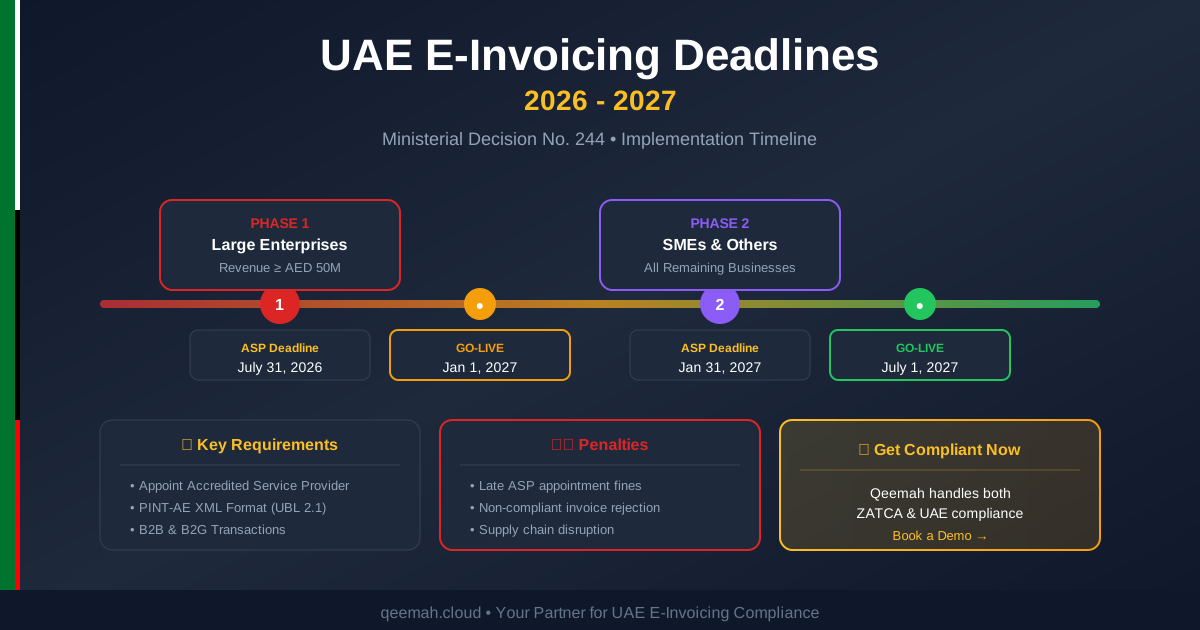
The Implementation Timeline (Ministerial Decision No. 244)
The rollout is phased based on revenue thresholds, giving businesses time to prepare. However, the deadlines for appointing an Accredited Service Provider (ASP) come months before the actual “Go-Live” date.
Phase 1: Large Enterprises
- Who: Businesses with revenue ≥ AED 50 Million.
- ASP Appointment Deadline: July 31, 2026.
- Full Implementation Deadline: January 1, 2027.
Phase 2: SMEs & All Others
- Who: Businesses with revenue < AED 50 Million.
- ASP Appointment Deadline: March 31, 2027.
- Full Implementation Deadline: July 1, 2027.
Voluntary Phase (The Strategic Move)
- Starts: July 1, 2026.
- Why join early? Testing your ERP integration during the voluntary phase allows you to fix errors without the risk of fines. It also positions your business as a compliant partner to larger Phase 1 clients who may require digital invoices earlier.
Important Note: This timeline is based on Ministerial Decision No. 244 of 2025 regarding the implementation of the Electronic Invoicing System 1.
Understanding the “5-Corner Model”
If you are familiar with the Saudi ZATCA model (which is centralized), the UAE system is different. It uses a Decentralized Continuous Transaction Control and Exchange (DCTCE) model, often called the “5-Corner Model” based on Peppol standards 2.
- Corner 1 (You/Supplier): Your ERP (like Qeemah) generates the invoice.
- Corner 2 (Your ASP): You send the data to your Accredited Service Provider. They validate it and convert it to PINT-AE format.
- Corner 3 (Buyer’s ASP): Your ASP sends the invoice securely to the Buyer’s ASP via the Peppol network.
- Corner 4 (Buyer): The buyer receives the validated invoice in their ERP.
- Corner 5 (FTA): Your ASP automatically reports a subset of data (Tax Data Document) to the Federal Tax Authority.
Key Takeaway: You do not send invoices directly to the FTA portal manually. Your software must talk to an ASP.
Technical Requirements: PINT-AE & UBL 2.1
Gone are the days of Word and Excel invoices. The new standard is PINT-AE, a UAE-specific customization of the international Peppol BIS Billing 3.0 standard 3. For a comprehensive explanation of PINT-AE and why PDFs are no longer accepted, see our detailed PINT-AE guide (Arabic).
- Format: XML (Universal Business Language 2.1).
- Mandatory Fields:
- IBT-001: Unique Invoice Number.
- IBT-031: Seller TRN (15-digit).
- IBT-005: Currency Code (e.g., AED).
- IBT-024: Specification ID (
urn:peppol:pint:billing-1@ae-1).
- Digital Signatures: Every invoice must be cryptographically signed to ensure authenticity.
What Should UAE SMEs Do Now?
0. Register on EmaraTax
Follow our step-by-step EmaraTax registration guide to set up your account and appoint an Accredited Service Provider before the deadline.
1. Audit Your Current Software
Does your current accounting software support XML generation? Can it integrate with an ASP API? Many legacy desktop systems will struggle with these requirements.
2. Clean Your Data
The new system rejects invoices with missing or incorrect data. Ensure all your customer records have:
- Correct TRNs (Tax Registration Numbers).
- Proper addresses (Emirate, City, PO Box).
- Valid commercial registration details.
3. Plan for “Dual Compliance”
If you operate in both Saudi Arabia and the UAE, you need a system that handles ZATCA (Phase 2) and UAE (PINT-AE) simultaneously. The workflows are different—ZATCA requires clearance/reporting to a government portal, while UAE requires routing through an ASP network.
How Qeemah Helps
Qeemah is built for this region. We are already the leaders in ZATCA Phase 2 compliance, and our platform is ready for the UAE mandate.
- One-Click Compliance: We handle the complex XML conversion and ASP routing in the background.
- Local Support: Our team understands the specific needs of UAE businesses, from VAT rules to the new Corporate Tax integration.
Ready to future-proof your business? Contact us for a free consultation on your UAE e-invoicing strategy.
References
Footnotes
-
Ministry of Finance, Ministerial Decision No. 244 of 2025 on the Implementation of the Electronic Invoicing System. ↩
-
Ministry of Finance, eInvoicing System, Official Link. ↩
-
Complyance, “What Is PINT AE? The UAE’s Official E-Invoicing Specification Explained”, accessed December 25, 2025. ↩