Strategic Evaluation of Cloud Accounting Infrastructure in Saudi Arabia: Zoho vs. Qoyod vs. Wafeq
An expert analysis of the top accounting platforms in Saudi Arabia—Zoho Books, Qoyod, and Wafeq—focusing on ZATCA Phase 2 compliance, technical architecture, and industry-specific fit.
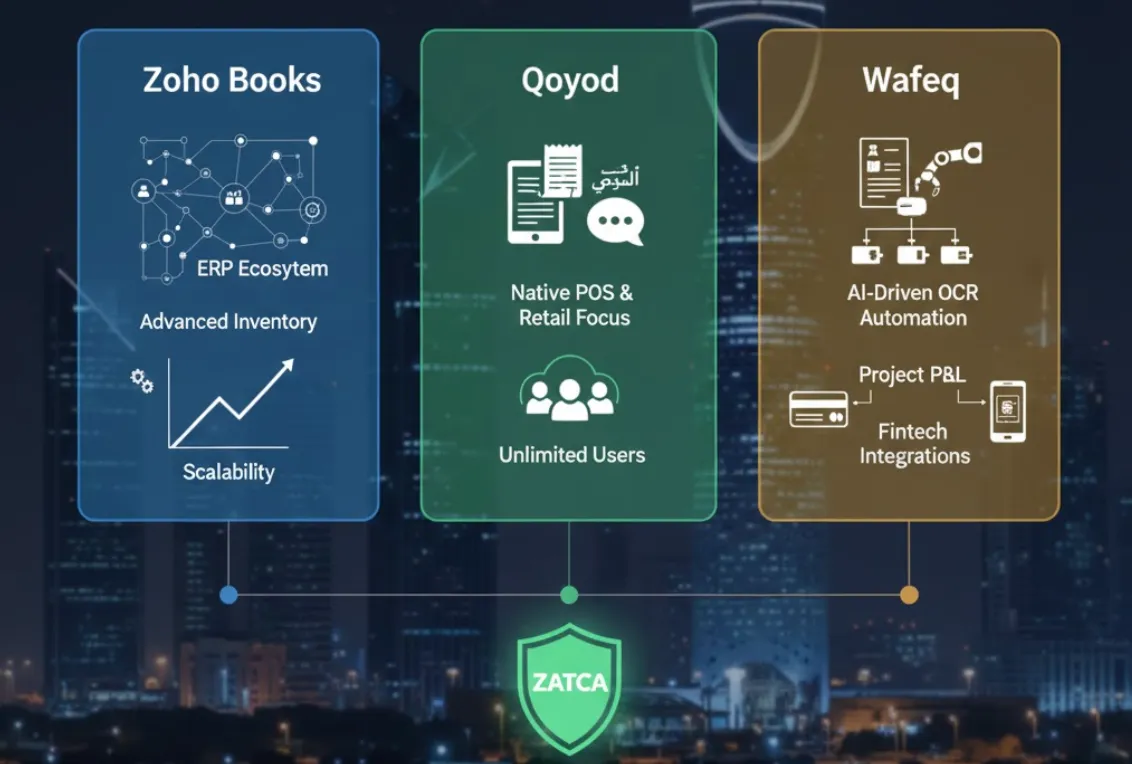
Strategic Evaluation of Cloud Accounting Infrastructure in Saudi Arabia
A Comparative Analysis of Zoho Books, Qoyod, and Wafeq
1. The Saudi Digital Economy and Regulatory Imperative
The Kingdom of Saudi Arabia (KSA) is currently undergoing one of the most aggressive digital transformations in the global financial sector, driven by the overarching Vision 2030 framework. This national agenda has fundamentally altered the operational landscape for businesses, shifting the selection of accounting software from a back-office administrative choice to a critical strategic decision involving compliance, interoperability, and operational resilience.
The primary catalyst for this shift is the Zakat, Tax and Customs Authority (ZATCA) and its imposition of the e-invoicing (Fatoora) mandate, which has necessitated a move away from legacy, disconnected systems toward integrated cloud-based solutions.
In this rapidly evolving environment, three primary software platforms have emerged as dominant contenders, each representing a distinct philosophical and architectural approach to solving the “Saudi Accounting Problem”:
- Zoho Books: A global heavyweight, offering a comprehensive “Operating System” approach with deep customizability.
- Qoyod: A homegrown Saudi solution, focusing on accessibility, native localization, and seamless Point of Sale (POS) integration.
- Wafeq: A modern challenger, leveraging advanced automation, fintech integrations, and project-based accounting.
This report provides an exhaustive, expert-level analysis of these three platforms, analyzing technical architectures, API maturities, compliance mechanisms, and total cost of ownership (TCO) to guide strategic decision-making for Saudi enterprises.
1.1 The ZATCA Fatoora Mandate: The Technical Filter
To evaluate these platforms, one must first understand the technical rigor of the regulatory environment. The Fatoora regulation is not merely about digitizing paper; it is about establishing a real-time data link between the economy and the sovereign tax authority.
- Phase 1 (Generation Phase): Implemented in December 2021, this phase eliminated manual invoicing. It required compliant software to generate invoices with specific technical attributes, primarily an audit trail and a QR code.
- Phase 2 (Integration Phase): Commencing January 1, 2023, this phase requires direct integration between the taxpayer’s system and the ZATCA Fatoora portal.
The requirements differ based on transaction type:
- Standard Tax Invoices (B2B): Must be transmitted to the ZATCA portal in real-time for “Clearance.” The software must generate a UBL 2.1 XML file. ZATCA validates and returns it with a cryptographic stamp.
- Simplified Tax Invoices (B2C): Typical for retail, these must be “Reported” to ZATCA within 24 hours. They require a cryptographic stamp generated by the software itself and must satisfy hash chaining requirements to prevent tampering.
2. Zoho Books (Saudi Edition): The Enterprise Ecosystem
Zoho Books is the financial core of the Zoho One suite. For Saudi businesses, it represents the “scalability” option, offering depth in inventory and multi-currency handling.
2.1 Architectural Depth and Customization
Zoho’s defining characteristic is its malleability via Deluge, its proprietary scripting language. This allows businesses to build “Custom Functions” to automate complex logic, such as automatic credit checks for high-value sales orders.
2.1.1 Inventory Management Superiority
Zoho Books stands alone in inventory sophistication, supporting Composite Items (bundling), Serial Number Tracking, and Batch Tracking. This is critical for electronics retailers (warranty tracking) and pharmaceutical/F&B distributors (expiry tracking).
2.2 ZATCA Phase 2 Implementation
Zoho has localized its engine for KSA, but the setup retains an “IT-heavy” feel. It requires generating an OTP from the Fatoora portal to generate the CSID. While robust, it enforces strict data validation (e.g., mandatory Arabic fields), which reduces rejection chances but increases the onboarding burden.
2.3 Banking and Payments
Zoho utilizes global aggregators like Yodlee. However, Saudi banks frequently update MFA protocols, which often breaks these “live” feeds, requiring manual CSV imports. On the payment side, it integrates well with local gateways like PayTabs, HyperPay, and Checkout.com.
3. Qoyod: The Local Champion for SMEs and Retail
Qoyod targets business owners who may not have a dedicated accountant, focusing on “simplification” and native localization.
3.1 The “No-Accountant” Philosophy
Qoyod’s dashboard prioritizes visual metrics like Cash Flow charts over complex ledgers. The terminology is localized to Saudi business vernacular, making it highly accessible to local entrepreneurs.
3.2 The Native POS Advantage
A significant differentiator is Qoyod’s Native POS system. Unlike competitors relying on third-party integrations, Qoyod offers its own POS software optimized for Sunmi hardware. Data synchronization is seamless, with no API latency or sync error risk.
3.3 Integration Landscape
Qoyod embraces integrations for e-commerce (Salla, Zid) and HR (Jisr), solving major pain points for SMEs regarding web orders and payroll/GOSI compliance.
3.4 Pricing Strategy
Qoyod charges for feature depth rather than headcount. Its “Advanced” plan offers Unlimited Users, a massive strategic advantage for businesses with large teams compared to Zoho’s strict user caps.
4. Wafeq: The Automation and Fintech Innovator
Wafeq positions itself as a modern, developer-friendly alternative, finding strong fit in the Construction/Contracting sector and high-growth startups.
4.1 Automation-First Architecture
Wafeq features a dedicated “Inbox” with a built-in OCR engine that extracts data from supplier invoices automatically. This is a significant productivity booster compared to manual entry.
4.2 Niche Dominance: Construction and Projects
Wafeq treats Projects and Cost Centers as first-class citizens. It generates real-time P&L statements per project, allowing contractors to track site-specific profitability effortlessly.
4.3 The Foodics Integration
For the F&B sector, Wafeq relies on a deep integration with Foodics. It handles complex logic for refunds, void orders, and inventory COGS entries automatically, making it the preferred “backend” for restaurant operators.
4.4 Fintech Integration
Wafeq is pioneering the convergence of accounting and banking, integrating with Wio Business and Stripe to close the loop between “Bill Received” and “Bill Paid.”
5. Comparative Domain Analysis
| Feature | Zoho Books (Saudi) | Qoyod | Wafeq |
|---|---|---|---|
| ZATCA Setup | High Friction (IT-heavy) | Low Friction (Wizard) | Medium (API-first) |
| POS | Third-party / Complex | Native & Seamless | Third-party (Foodics) |
| Bank Feeds | Aggregator-based (Unreliable) | Manual focus (Reliable) | Fintech-forward (Wio) |
| Inventory | Advanced (Serials/Batches) | Basic Retail | Value-based |
| Data Entry | Manual / Scripted | Manual | Automated (OCR) |
6. Strategic Implementation Framework
Choosing the right software depends on your business model:
- The Retailer (Grocery, Boutique, Kiosk):
- Recommendation: Qoyod. The native POS is the deciding factor. It ensures a unified system where the register talks directly to the ledger without API breaks. For a detailed comparison of ZATCA-compliant POS systems in Saudi Arabia, see our Best POS Software Saudi Arabia 2026 guide.
- The Contractor / Project-Based Agency:
- Recommendation: Wafeq. Construction lives and dies by “Project Profitability.” Wafeq’s architecture makes site-specific P&L reporting effortless.
- The Distributor / Wholesaler (Electronics, Pharma):
- Recommendation: Zoho Books. You cannot legally run these businesses in KSA without Serial Number and Batch tracking, which only Zoho handles natively in this tier.
- The F&B Operator (Restaurant, Cafe):
- Recommendation: Wafeq (with Foodics). The integration is the gold standard for handling F&B nuances like modifiers and waste.
7. Future Outlook and Conclusion
As Saudi Arabia moves toward Open Banking (SAMA mandate), the “Bank Feed” gap will likely close. However, local players like Wafeq and Qoyod are positioning themselves as “financial operating systems” by integrating banking actions, not just data.
Final Verdict:
- For Complexity & Scale: Zoho Books.
- For Simplicity & Retail: Qoyod.
- For Efficiency & Projects: Wafeq.
This report was prepared by a Senior Digital Transformation Consultant for the MENA region. For more insights on ZATCA compliance and cloud accounting, visit our ZATCA Hub.